


Last week, Amazon’s “The Rings of Power” returned for Season 2, so I’ve been in a Tolkien mood of late. I tend to satiate these cravings not just by re-reading the books or watching the movies but also by engaging with fan-made content online. YouTube is replete with lore videos by ardent superfans, many of them dedicated to whimsically relaying details of Tolkien’s legendarium in engaging, bite-sized servings.
One such video by YouTuber Nerd of the Rings reminded me of just how beautifully and subtly Tolkien managed to weave Christian themes into his world. Eru Ilúvatar1 shares many obvious qualities with the God we find in the Bible, and one I’d like to focus on today is his desire to share the work of creation with his created children.
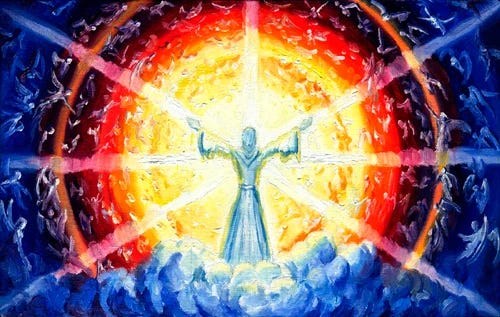
Creation in Tolkien’s world begins with Ilúvatar’s divine council: the angelic “Ainur” (referenced by Tolkien as “the offspring of his [Ilúvatar’s] thought”), who then become participants in the act of creating Arda and some of its creatures. The initial creative act is described as a song: the “Music of the Ainur:”
“Then Ilúvatar said to them: ‘Of the theme that I have declared to you, I will now that ye make in harmony together a Great Music. And since I have kindled you with the Flame Imperishable, ye shall show forth your powers in adorning this theme, each with his own thoughts and devices, if he will. But I will sit and hearken, and be glad that through you great beauty has been wakened into song.’
Then the voices of the Ainur, like unto harps and lutes, and pipes and trumpets, and viols and organs, and like unto countless choirs singing with words, began to fashion the theme of Ilúvatar to a great music; and a sound arose of endless interchanging melodies woven in harmony that passed beyond hearing into the depths and into the heights, and the places of the dwelling of Ilúvata were filled to overflowing, and the music and the echo of the music went out into the Void, and it was not void.”
We’ll return to this symphony after a brief sojourn through this story’s counterpart in Genesis.
The cosmogony of Genesis 1 presents a slightly different picture of things than we’re used to imagining. Keeping with the cultural conventions of the ancient Near East, we find primordial waters of chaos alongside God “in the beginning.” The picture in Genesis 1 is not, on a literal reading, the traditional picture of creatio ex nihilo (though despite what some skeptics may insist, it is perfectly compatible with the doctrine). Worrying about aligning the primeval narratives of Genesis with a historical timeline is something of a category error, so let us instead ask a theological question about this account: when is creation “good?”
I’ve been wrestling with the question as to whether or not it is a Christian position to say that simply to exist is a moral good in itself. After all, God is the Good as such and God is Being as such. All participation in existence is sustained by God and so at first glance, it would seem that merely to partake in Being can be construed as a good all on its own.2 Meditating on who God is (“I am”) and the potential cost of creation (paid by Christ on the Cross), has led me to, at present, tentatively embrace an affirmative answer: to exist in the Good, is good…at least at some basic level.
But the picture in Genesis 1 may offer better insight. Genesis 1 presents “existence” as already, in some sense, existing. The Earth was “welter and waste” (as Robert Alter’s magnificent translation renders it), but it was still there. God’s act of creation, at first, is as much an act of ordering and separating as it is generating. He bends the primordial forces of chaos into ordered shapes, he claws back the ocean from the shoreline, he casts light into the darkness, he places a firmament above the land to shield it from the waters, and only once he has cultivated the space for growth does he cause all things to grow.
It is not when things merely exist that they are called “good,” it is when God has finished his transformative work within them. And this perfectly aligns with our lived experience. Speculating on the prelapsarian state of things can be a fun exercise but no human alive has ever known that world. Trying to use earthly power to rebuild Eden is a recipe for Babel and every political movement selling itself on a return to the mythical “good old days” typifies this truth. The world as we know it is broken and is only made good through the redemptive and transformative power of the kingdom of God, and that truth extends to every human being. Until we are in Christ, we are not made. Only when He says “it is finished” can we call it good.
God’s act of creation, whether from the chaotic waters of the deep as in Genesis 1, a song in the Void as in Tolkien, or as a redemptive act of renewing brokenness as we see in the fallen world around us, is always more than merely causing something to exist- it is rescue, renewal, restoration. The entirety of God’s work is encapsulated in the picture of bringing something out of nothingness- devising ultimately good ends for attempted evils and working all things together for the good of those who love him.
“And thou, Melkor, shalt see that no theme may be played that hath not its uttermost source in me, nor can any alter the music in my despite. For he that attempteth this shall prove but mine instrument in the devising of things more wonderful, which he himself hath not imagined.”3
As Christians, this is the work we are called to do. The good, transformative, redemptive work of God is the Kingdom of Heaven within us, the Kingdom we are called to participate in building, not through the dominance of social systems or the imposition of legalistic mandates upon our fellow man, but by loving them as neighbors. Love itself is an act of creation in its oldest, most primordial, and first recorded form: love is an act of casting forth light into darkness.
“In love did He bring the world into existence; in love does He guide it during this its temporal existence; in love is He going to bring it to that wondrous transformed state, and in love will the world be swallowed up in the great mystery of Him who has performed all things; in love will the whole course of the governance of creation be finally comprised.”4
The legends of Arda look forward to the Second Music of the Ainur, which shall take place “after the end of days.” The primary distinction in this second song is its participants - the Children of Ilúvatar (Elves, Men, etc) join the Ainur in the song. God and the Divine Council,5 who fashion mankind in the Image of God, now invite this creation into the creative act. Our Biblical picture of the New Heavens and the New Earth, like the renewed Arda foreseen in the Ainulindalë, is one of harmony, of participation, of the Image in the created reflecting the nature of their Creator through a partaking of the divine essence, joining in the symphony of creating with unveiled faces, transformed and transcending the furthest limits of our heart’s imaginative desires from one degree of ineffable glory to another, forever and always “further up and further in.”
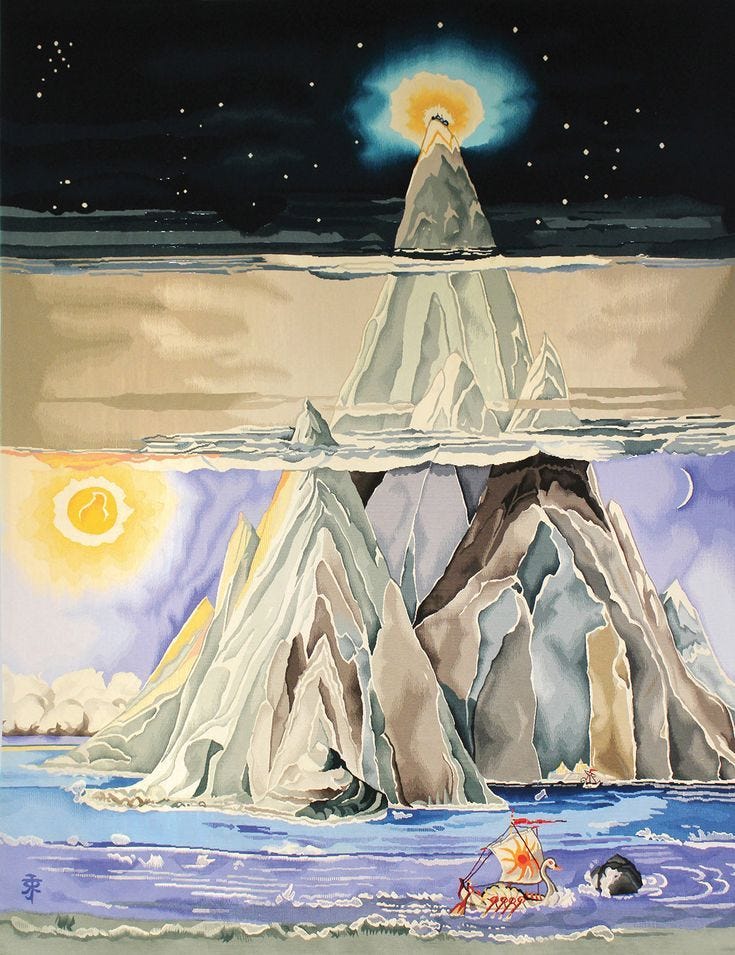
God, basically.
At least, in the abstract. There are numerous counters to this argument if approached through our experience of reality…one can easily construct a scenario where existence is so meaninglessly torturous that perhaps oblivion really is the better alternative, at least at an intuitive level. I think these counters are valid and worth consideration, though I shall not dive into them here.
Tolkien, J.R.R. The Silmarillion. Edited by Christopher Tolkien, Houghton Mifflin, 1977.
St Isaac the Syrian, The Second Part, Chapter 38
The “us” in “let us make” from Genesis 1. Interestingly, Tolkien inverts the Genesis accounting of their participation in creation. He very clearly specifies when speaking of the creation of Men and Elves that “the Children of Ilúvatar were conceived by him alone…and none of the Ainur had a part in their making," so while Tolkien’s angels sing to help create the world, they do not participate in making man or Elves (though some craft the other races). Genesis 1, on the other hand, ascribes the making of all things to God alone, it is only once we arrive at mankind that the divine counsel is invoked (“let us make man in our image”).
I really like the way you write. And your use of “Further up and further in” is one of my favorite images of life after passing thru that last door. Thanks Benn