


Earlier today, I came across a few social media posts rejoicing over the apparent deathbed conversion of Dilbert creator Scott Adams. Beyond his comic-strip fame, I can’t pretend to know much of anything about Adams, though I’m vaguely aware that he’s been a voice in conservative politics over the last few years to some online degree. My goal here is not to decry a dead man’s faith (or lack thereof), nor to explain why this conversion doesn’t “count” or anything like that.1 This article isn’t really about Adams at all, but it seemed like a perfect opportunity to remark on the transactional way we conceptualize things like faith and salvation, because I think Adams was well within the norm in the way he expressed his apparent conversion.
The first post I saw was jubilant, quoting Adams’ last words as “I accept Jesus Christ as my lord and savior, and I look forward to spending an eternity with him.” That sure does sound like a deathbed confession! But in context, what Adams actually said was this:
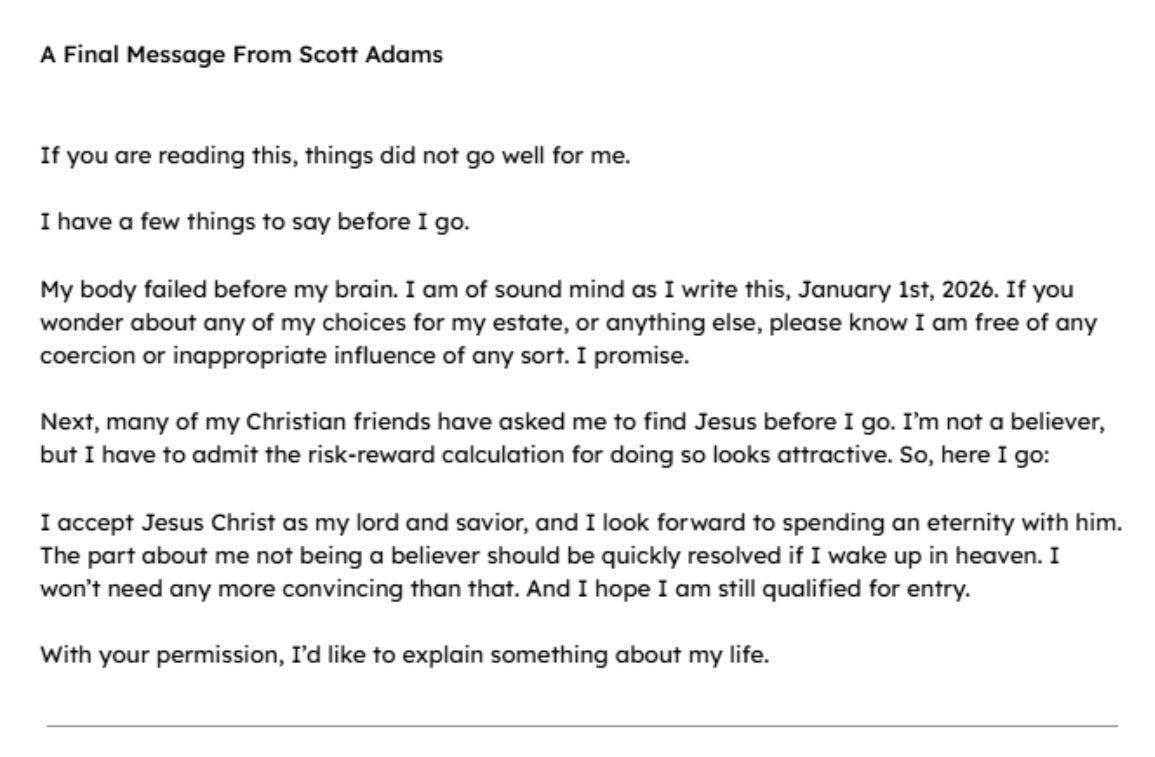
A few things stand out to me. The first is that he qualifies the statement of belief with “I am not a believer.” The second is that he contextualizes his profession of faith as a “risk-reward calculation.” The third is that he expresses hope that he is “qualified for entry.”
Let’s start with “I am not a believer.” This really should be the thesis for the rest. Adams, by his own admission, does not actually believe. But even that use of “believer” spells out something central to this conversation. When we speak of “believing” in Jesus, or in any religion, we mean that in the sense of “I think this is true.” To believe in Christianity is to assent to a set of abstract propositions about it, usually things like the sacredness of Scripture, the historicity of the resurrection, and often a sense of present relationship with God. But the profession of belief is so frequently emphasized, epitomized in how the classic “sinner’s prayer” is used as a shorthand for conversion.2 I would hardly be the first writer to point out that language like “I accept Jesus Christ as my personal Lord and Savior” is not found even paraphrastically in the Bible, and that the language we do find differs significantly in emphasis. To “proclaim Christ as Lord” in the New Testament was more than a profession of belief; it was a political challenge against the institutions of the day.3 If Christ is Lord, Caesar isn’t. Furthermore, when we read “faith” in the New Testament, we can sometimes ascertain a more immediate sense of the meaning by mentally substituting the word “trust.” I would encourage you to go look up examples of this and see for yourself how “trust me” usually makes better sense of the context than “accept the validity of these facts.”
And while this may seem like one of those philosophical nitpicks good only for ponderous Substack dorks like myself, it really does affect our mindset, even if we don’t realize it. If the primary component of belief is mental assent to factual propositions, then actions meant to derive from that belief are a secondary effect, not a causal component. Or put more simply: there are two aspects to the Christian walk, believing the right things and then behaving the right way. If you believe the right things, that should theoretically affect the way you behave, but if the belief is the essential component, the thing that “gets you into heaven,” then the actions, while nice, are easily reduced to a secondary bonus. They are meant to follow from your belief, but the belief is what really matters; the mental assent is the salvific priority.
Now I won’t get into all the complicated theological history here,4 but I will say that I think this mindset is a natural result of bifurcating “faith” and “works” as distinct theological categories when really, they should be viewed as singular and inextricable. St. James, in his epistle, seems to push back against this separation occurring in his own day:
What good is it, my brothers and sisters, if someone claims to have faith but does not have works? Surely that faith cannot save, can it? If a brother or sister is naked and lacks daily food and one of you says to them, “Go in peace; keep warm and eat your fill,” and yet you do not supply their bodily needs, what is the good of that? So faith by itself, if it has no works, is dead.
But someone will say, “You have faith, and I have works.” Show me your faith apart from works, and I by my works will show you faith. You believe that God is one; you do well. Even the demons believe—and shudder. Do you want to be shown, you senseless person, that faith apart from works is worthless?
I think the focus on technicalities of “salvation” distracts us from the more essential (and simple) point being raised here: that there can be no true separation of one’s faith and one’s actions. If you claim to be a follower of Christ, in what sense can that be true if you don’t act like it? What good is saying you affirm particular facts of history if you don’t live like it’s true? James even goes so far as to point out that mere “belief” is worthless, as even the enemies of God “believe” in him.
All of this, ultimately, is to agree with Adams. By his own admission, he was not a believer. He did not live like the story of Christ’s cosmic rescue of the universe is a true story. He did not accept that narrative, either factually or experientially. Which makes his next words all the more interesting. If, as he states, Adams was not a believer, what on earth does the proclamation of “accepting” Jesus even mean? Again, I don’t blame Adams for this at all; I think it’s indicative of the reductionist binary we’ve simplified faith into, as if the entire story comes down to an on/off switch. Adams quite literally seems to be operating under the assumption that the sinner’s prayer operates like a magic spell, or a password to get into a clubhouse. He does not believe, but just in case, he says the right words, hoping that it checks a box on St. Peter’s clipboard and earns him entry past those pearly gates. Adams has bought into the notion that God saves or damns based on technicalities, as if entry to heaven follows from scanning a transcript of your lifetime to check if you verbally stated what team you’re on.
But he also adds that he hopes he is “qualified for entry.” This third and final aspect, I think, is the most telling of his mindset. While I’m sure his “I accept Jesus” profession factors into his hypothetical qualification, Christians and non-Christians alike have a colloquial understanding that “going to heaven” is essentially a merit-based process. 5 While Christians may claim to believe in salvation by grace alone or some similar formulation, in truth, most believe in karma. It’s an intuitive position, the notion that generally good people do not deserve to be punished forever, but very bad people might. Or at least, very bad people do not deserve an eternal reward for their horrible lives. And Adams seems to be thinking to himself (as he expresses later in his statement) that he strove to be a generally good person and live a generally good life. So he (again, intuitively) hopes that some combination of good karma and a final Pascal’s Wager affirmation of Christ’s lordship may be just enough to get him over the finish line. But all this tells us is how fundamentally the “Christian friends” Adams referred to failed to help him understand what salvation is in the Christian story, how they equipped him with this simplistic binary and hoped that at some point, he could “join their team” with a loyalty pledge, rather than transform his life through the pursuit of Christ’s Way.
I won’t lengthen this post with a thorough corrective to this view (you can read some of my attempts to do so here), but I do think it’s worth recognizing that this simplistic, transactional understanding of the Christian story is, at least to my understanding, the culturally dominant one in the West. And while great writers like N.T. Wright, David Bentley Hart, Pete Enns, Brad Jersak, and countless others have published excellent books in recent years pushing back against this crass binary; their theologically sound and biblically informed perspective has been slow to make its way into the zeitgeist, and thus we are left contending with this “magic spell” version of conversion.
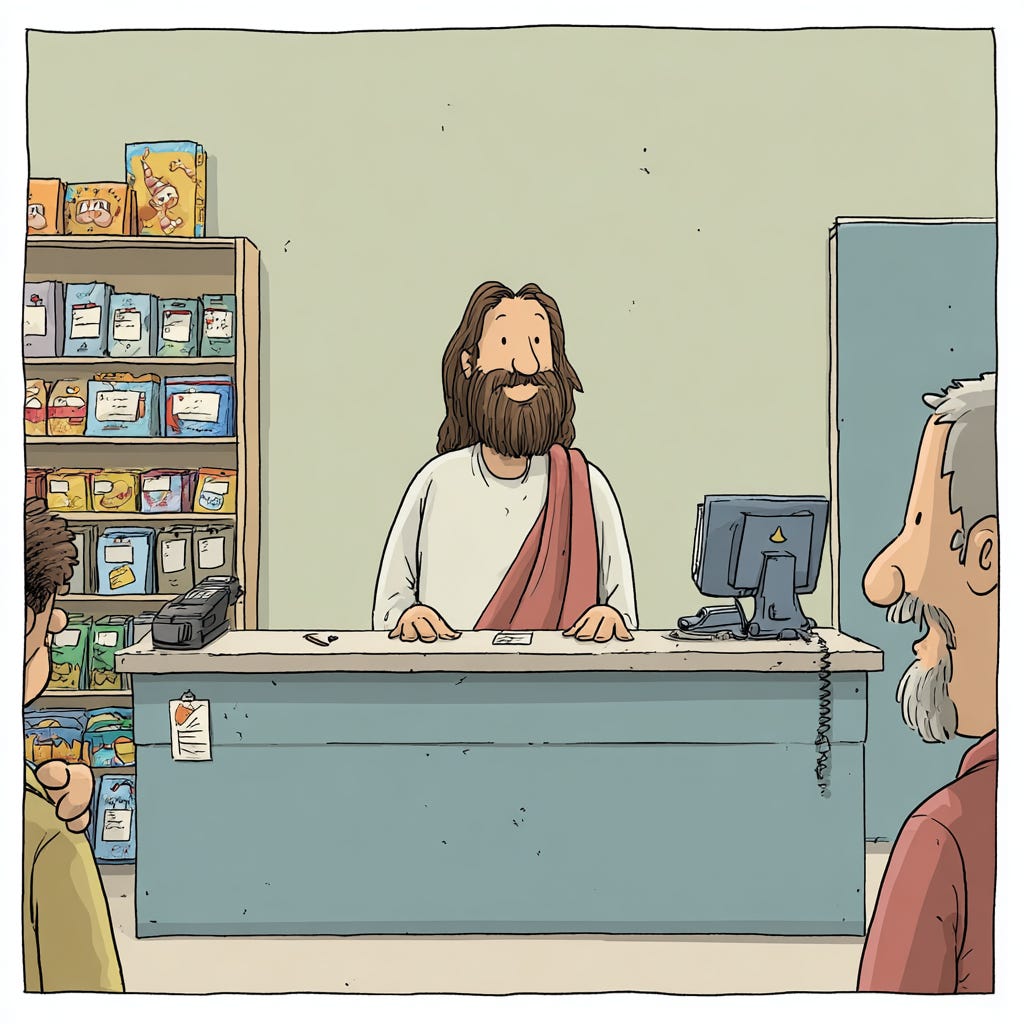
But lastly, in defense of Adams, there is a good-faith way we can take his words. In one of the stories found in Mark 9, upon hearing that all things are possible to those who believe, the father of a demon-possessed child cries out, “I believe, help my unbelief!” I love the beautifully human sincerity of this paradoxical proclamation. The father believes, but does he believe enough? Does he believe truly? Does he even know what it means to believe? We don’t know. What we do know is that in his uncertainty, he cries out to Jesus for help. There is a sense in which we can read Adams’ “risk-reward” calculation in this same light. He does not believe, but if he is wrong, help his unbelief. He may have framed it as hedging his bets, but there may be a very real sense in which facing death opened him to genuine consideration of these matters, perhaps for the first time in his life. We cannot know for sure. All I know is, from my vantage point, Adams’ deathbed conversion feels very cheap. And again, I don’t blame him for his understanding of how conversion works. If he was trying to give his life to Jesus at the last moment, he presumably did so in the way his aforementioned Christian friends taught him. But a faith that can be reduced to nothing but an “opt-in” as a final hedged bet, like grabbing a last-minute candy bar in the checkout line, is a cheap faith, and it is to our own shame that we Christians have allowed the spectacular tale of God’s loving rescue of the cosmos to be reduced to such an empty transaction.
I have a lot more I could say here,6 but instead of rambling on, I’d like to leave you with a question by way of a thought experiment. If you are someone who believes in any variant of Heaven, Hell, or the Christian afterlife, I would really like to know your response to this, so please leave a comment or shoot me an email.7 I came up with this a while ago, and I think it’s an interesting way to assess our own frameworks for how we view belief, behavior, and God’s role (as opposed to ours) in the context of salvation.
Once upon a time, there was a man named John-Mark, but he went by just “Mark.” Mark was raised in a good Christian home, and after graduating from high school, chose to pursue a career in ministry, eventually becoming the Pastor of a small church. By all accounts, he was a decent man, well-liked by his congregants, if a bit bombastic at times. He was married with two kids by age 30 and lived a peaceful, small-town life.
At the age of 35, Mark was in a terrible car accident. He spent months in a coma, and when he finally woke up, his memory was gone. A nurse told him his name, but he only heard “John,” and so during his recovery, he came to prefer John to his full name.
The recovery was lengthy and difficult, and while he was eventually cleared to return home, John was a changed man. He sincerely tried to make things work with his wife, but she couldn’t endure being married to a stranger, so after a time, they amicably divorced. John ended up leaving town to start over. He settled on a new vocation as a truck driver and lived the rest of his life on the road, exploring an unfamiliar world. During his travels, he met a woman who became his second wife, and they raised one child together. John no longer believed in God, though he passively accepted his wife’s Buddhist faith and let her teach some of its principles to their son, even though he never really embraced them himself. John died at the ripe old age of 87.
So the question is this. By your understanding of faith and salvation (and skipping the reasonable answer of “we can’t know for sure,” this is a thought experiment, not a test), is John-Mark saved? Damned? Something else entirely?
I’d be very curious to hear how any of you answer this question.
As someone once said, it is unwise to speak with any certainty about the furniture in Heaven or the temperature in Hell.
This singular “moment” of conversion is interestingly contrasted against practices found in many of the older denominations, where Baptism is the culmination of a (sometimes lengthy) process of catechesis. It’s notable to ask, in these traditions, if there can even be said to have been a “moment” of conversion in the commonplace sense.
And in a better world, it still would be.
If for no other reason than I am supremely unqualified to do so, I am sorely lacking in knowledge on the Reformation.
Personally, I think the entire framework of “going to heaven” is misplaced. The idea that the story of salvation is about “where you go when you die” is utterly absent from the Bible. I employ it here to engage with the colloquial understanding of this subject, but I do not think this understanding is a good one.
Isn’t it interesting how we almost exclusively talk about being “saved” or not in terms of our behavior or beliefs or whatnot, with almost nothing said about God’s role in the process? I think this entirely misses what salvation is but that’s a whole other essay…
And even if you don’t believe, feel free to weigh in anyway!
In your thought exercise, John-Mark chose a career in ministry, but was he a Christian?Was he led to ministry by the holy spirit or just selecting a respectable occupation? He lived a decent life, but did he walk with Christ? The scenario paints a picture of an individual who did good works but only he knew his heart. I would like to believe that even after the accident if he truly believed in Christ as his Lord and Savior he would be guided once again by the Holy Spirit, but the absence of a profession of real faith conversion leaves me with doubts of salvation.
Nice article , i really enjoyed the balanced approach to the diciest of all theological topics — speculation on eternal destinations!
As to your fun thought experiment, i’ll offer my best of a guess. the man will be allowed to experience the fires of God’s love, and this purgative restoration will lead him back to the one he first loved, and he will be caught up in the eternal act of God- restoring all to the Son.
there is more that could be said, but i think it is best answered as abstractly as the question allows!