


Future historians and anthropologists may never be able to pinpoint the very first “Facebook tribute,” but they will doubtless note the phenomenon. Anyone savvy enough to check their email and read this article is likely familiar with, or has participated in, the common practice of posting a brief or lengthy Facebook status to commemorate the death of a friend or loved one. This convention exemplifies Facebook’s original function: a digital manifestation of a common social practice. Real life is replete with examples of gathering to honor someone who has passed, sharing stories, and toasting their memory. The cyber version of this does not innovate.
But with the dawn of AI, a new kind of social media tribute has taken root, and it’s horrifying. As an early adopter of AI art tools and now an active prophet of doom about said tools, the various AI-generated tributes to dead celebrities make my skin crawl with a weirdly primal variant of unnerving cringe. Whether it’s the dead-eyed, soulless memes placing them side by side with other famous deceased people, the frankly uncanny videos where they sprout blurry wings and jerkily trot into heaven to be embraced a plastic Jesus, or most recently (with Suno’s explosive popularity) the bizarre genre of “song tributes,” where ersatz shades of Adele or Frank Sinatra belt a few simplistic, poorly written (automated) stanzas in memory of the deceased. It’s scary enough how much of our work, thinking, and art we are now outsourcing to AI, but the fact that people are generating “tributes” from prompts makes it feel like we’re attempting to automate our grief, and I can think of few things more inhuman than that.
Of course, the most recent and widespread instance of this impulse comes via the death of Charlie Kirk. My purpose in this article is not to weigh in on the fractious contention regarding how he should be viewed in death1 and my remarks on images/video featuring him are not meant to comment on his positions or politics so much as the creation of the media itself. Again, Kirk is not the first example where AI-generated photos and videos have cropped up to honor the recently deceased, but I have never seen anything as extensive or bizarre as the hurricane of generated media in the wake of his death. Just in the last 24 hours, I remember seeing a photo of him standing next to Jesus and MLK,2 a handful of photos of him in various states of haloed sainthood, generated “song” tributes featuring a duet between Adele and Ed Sheeran, another where it was instead Eminem eulogizing him with rap, fake speeches from the President promising his wealth to Kirk’s family among other ludicrous claims,3 and most starkly, videos of him entering heaven in increasingly outlandish ways, from sprouting wings and ascending to the clouds, to one where the video of his death stops a few frames before the shot is fired and instead has Kirk leap over the table and scale a heavenly staircase into the waiting arms of an uncanny-valley Jesus.4 The one that inspired this video was a completely AI Kirk, intentionally framed as speaking from beyond the grave, alongside a digitally remastered Apostle Paul and a few others (click here to watch it if you dare, and you can see several similar examples in this thread).
However much someone may have admired Kirk, I do not understand how anyone looks at this and does not find it to be the creepiest thing imaginable. Digitally puppeteering a murdered man to spout platitudes days after his death feels cataclysmically detached from reality. Resurrecting (oddly European-looking) dead Saints to talk to you like some historical re-enactor at a children’s birthday party but played completely straight feels like a demonic manifestation of advertiser pandering. It’s distressing enough how comfortable we are with whitewashing people’s legacies in real time; are we really so quick to be comfortable with deepfaking them?
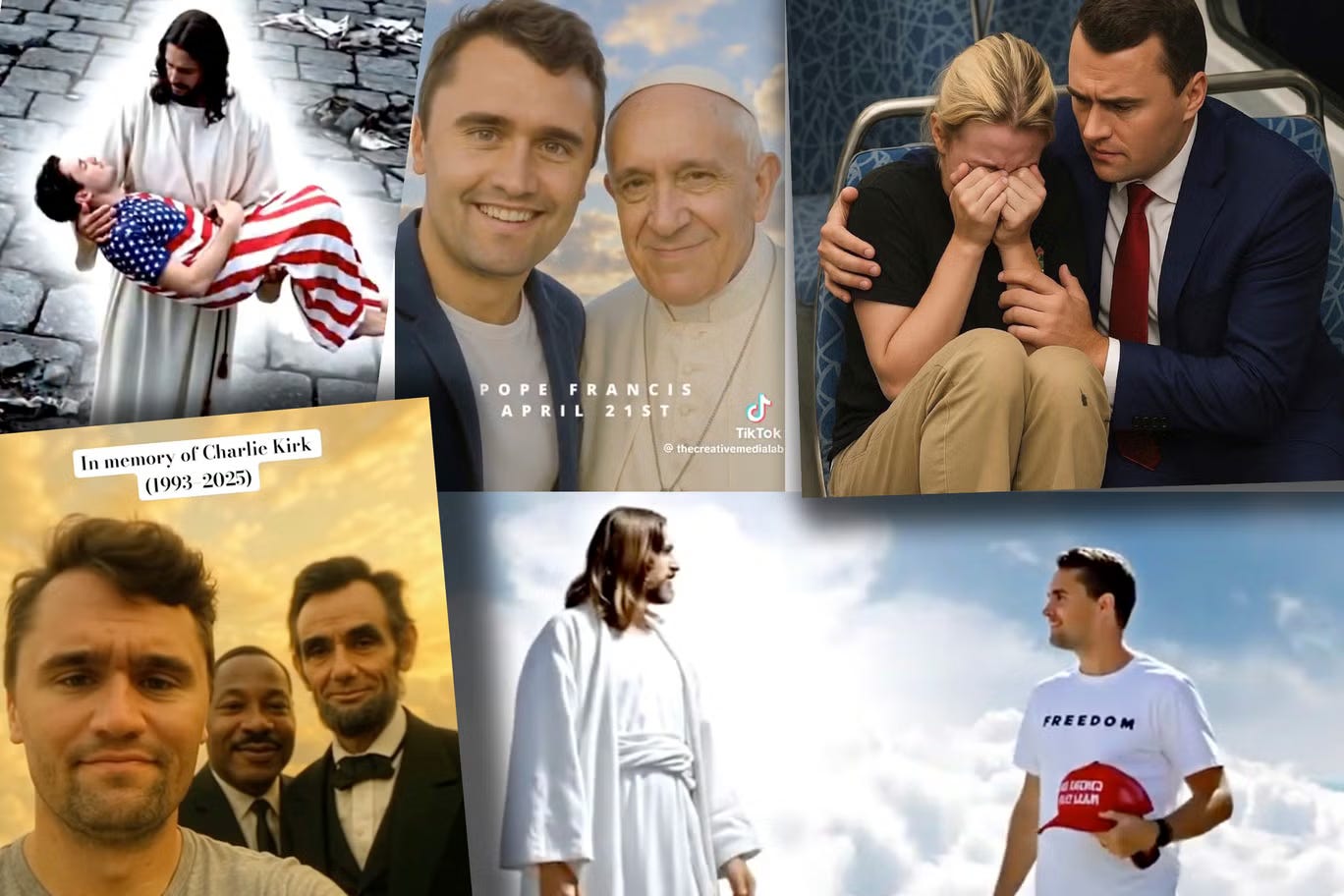
Humans have always expressed themselves through the artifacts and technology of their day, from elaborate gravesites to funerary inscriptions. However, unlike the Facebook tribute (digitizing an otherwise human effort), outsourcing these rituals to AI feels like an innovation on the practice, and not a positive one. Since its invention, the internet has had its own culture, from message board slang to early memes to whatever rampant irony now guides the humor of younger generations. Mainstream memes have largely adopted a level of nihilistic irony. Dark humor is no longer a novelty but a norm. As a frequent purveyor of dark humor, I’m not necessarily opposed to this, but when memes become the grammar of non-ironic attempts at expression, we enter a liminal space of freakishly bizarre interaction. It’s one thing to crack a dark joke at the death of a celebrity; it’s another to digitally resurrect that celebrity, put your words in his mouth, place him in the company of saints and heroes of the past, and pass the whole thing off as a somber tribute. Think of how many stories feature liminal encounters with ghosts or hallucinations posing as dead loved ones— that’s what is happening, only instead of happening in a cave saturated with the Dark Side of the Force, it’s happening on all of our feeds, and people we love are eating it up.
I saw a sobering analysis that posited we should view Kirk’s assassination through the lens of internet culture more than political culture. It’s less a matter of slotting the murderer into a neat camp of political ideology and more recognizing that, whether he was a groyper or a radicalized leftist, he seems to have viewed the assassination itself as a shitpost. The phrasings on the bullet casings, again, whether they were video game references or straightforward anti-fascist slogans,5 were, in both instances, first and foremost, memes. Explaining what a shitpost is might be beyond the scope of this article, but I think this hermeneutic is tragically worth considering, not just because it may give us insight into the mind of someone willing to commit an atrocity like this, but because I think many people responding in grief to this murder are adopting the same language. Memes are the grammar of the internet. The most effective marketing strategies, inside jokes, political propaganda, misinformation, radical ideology, all of these things spread furthest and most effectively through memes. And we’ve now reached a point where meme culture is not limited to the perpetually online, but has invaded the real world, seen in its most ghastly form by murders like Tyler Robinson or Brenton Tarrant (whose manifesto was saturated with 4chan memes and who referenced memes during his massacre), to whom real life acts of violence can be reduced to the jokes cracked about them online. And yet, I think these AI tributes to Kirk represent the exact same phenomenon, just from the other side, since fundamentally, an AI image of Kirk amongst a pantheon of martyrs is a meme.
A meme is an inside joke writ large. At the core of most meme-humor is a reference to something, some past instance of that meme, some viral trend, something that, if you do not recognize it, you will miss the intended humor. And like any inside joke, irony played straight for laughs can be accidentally taken seriously by someone not in on the joke, like someone reposting a headline from the Onion and not realizing it’s satire. I have been struggling to find the language to articulate it, but these AI tributes to Kirk evoke that same “not in on the joke” energy, even when no one is trying to be funny. The best comparison I can think of for the tone/energy/vibe I’m getting at is the Nathan Fielder sketch where a voice actor poses as a child’s dead pet and greets them from beyond the grave. In the case of Nathan For You, this is played for a laugh. Everything about it, from ludicrous premise to the cheap production to the out-of-touch concept of the whole scheme, is designed satirically, comically structured to evoke second-hand embarrassment. With these AI-tributes, we have something just as parodic, but the intention is no longer humorous.
I really don’t know what to call this. Post irony? Post memery? Whatever we call it, this macabre praxis of public grieving encapsulates so much of what’s scary about the digital age. The saying “the internet is not real life” feels less and less relevant, not just because of how much we all live online now, but because of how much from what used to be the domain of the perpetually online has escaped into the real world. Fringe conspiracists are now mainstream, “trolling” is now regularly practiced by the US government,6 and unfounded lunacy once reserved for the darkest corners of 4Chan is now espoused by prominent media figures and politicians alike. The darkest impulses of the internet, made in our image, are in turn re-making us in its image, and we are all poorer for it. Our digital facsimiles are quickly replacing our actual humanity, which is why this gruesome practice of emotionally manipulative generative media is only going to become more prominent.
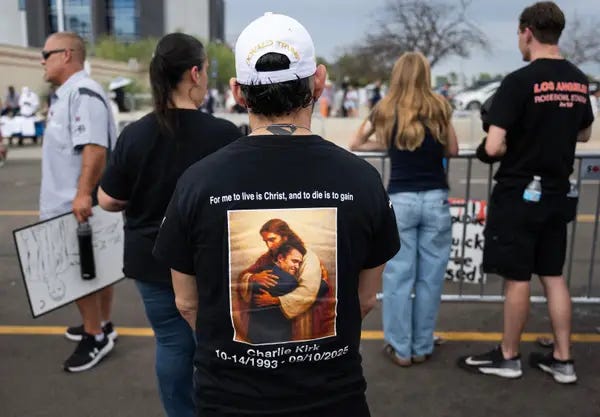
I have little to add to the many comments already provided by better writers on the political rally ostensibly masquerading as Kirk’s memorial service. While there was not, to my knowledge, any official appearance by Kirk’s re-animated digital spectre (at least on stage, there were plenty on signs and t-shirts), there was a predictable parade of partisan fervor in his name, and at a human level, I found it fairly ghastly. Celebrity is a dehumanizing phenomenon, reducing human beings to the sum of their branding, and in the digital age, parasocial relationships with celebrities border on outright psychosis. All of these negatives inherent to celebrity culture can be weaponized or exacerbated under the right circumstances, and Kirk’s murder has put that on display more loudly than anything in recent memory.7 I am of the opinion that opportunistically weaponizing his death and using his lifeless corpse as a political prop is just as disgusting as dancing on his grave.
But Erika Kirk stood out amidst the noise. Standing on stage amongst the star-studded cast of charlatans seeking to profit politically from her husband’s tragic murder, she did the most rebellious thing imaginable— she preached a Christian message. An actual Christian message, not the nationalistic imposture that has co-opted the faith in the US. While Steven Miller performed a near-perfect Joseph Goebbels impression and President Trump rambled on about himself, his (mostly fictional) accomplishments, and how he disagrees with Charlie Kirk about loving your enemies, Erika Kirk publicly claimed to forgive the young man who murdered her husband. For all the talk of Charlie Kirk as a champion of evangelism, this act by his wife was something I don’t recall meaningfully seeing from Charlie himself— subordinating one’s politics to the teachings of Christ instead of the other way around. Kirk’s murder elicited endless cries for retribution and war from innumerable hordes of his peers, cries echoed by speakers at the political rally held in his name, and continued in pushback against Erika Kirk’s Christlike rhetoric.
But Erika Kirk should receive due credit for holding fast against the tide of her husband’s allies. The strength it takes to stand before thousands and proclaim forgiveness is both admirable and touching. And more, it’s a better witness to the hope of the resurrection than any deviant attempt to reanimate the dead with AI. The contrast between Erika Kirk’s actual proclamation of a Christian message and the nearly ubiquitous divisiveness espoused by the other headline speakers feels like the perfect encapsulation of the contrast between her husband’s living words and the re-animated fabrication currently being disseminated both through revisionist hagiography and the freakish AI necromancy that triggered this article. These generated videos, however good they may get on a technical level, will always be digital imitations, algorithmic mirages, and like a true Christian message of forgiveness preached amidst a legion of those taking Christ’s name in vain, opportunistic, digitally generated imitations will always pale in contrast to the Real.
Though I’ll briefly note that I fall between the extremes. I view his death as a horrific tragedy, I oppose political violence, and I do not agree with those celebrating his murder as a positive. Simultaneously, I firmly reject the revisionist history attempting to paint him as some saintly bastion of honest interlocution, or even stranger, the bizarre falsehood that he was a martyr for his Christian faith. It is neither celebratory of his murder nor disrespectful to his memory to acknowledge that Kirk’s brand of semi-provocateur rhetoric and entire political project directly contributed to the increase of political tensions in our country.
We’ll set aside for now how Kirk himself might have viewed being counted in similar company to MLK…
The video, reposted by hundreds of people with complete sincerity, featured an AI-generated Trump saying that:
-Charlie and Trump had a mutual agreement that Charlie would run Trump’s funeral
-Trump has three things he needs to do to “let Charlie rest in peace” and also “have peace when I go,” which were 1. The killer must face the death penalty, so Trump will release “three pieces of top secret case evidence to ensure he receives the harshest penalty.” He promises to invite “Judge Judy and the country’s top judges” for a joint hearing. Also Trump is putting half his savings into Charlie’s “legal team.” 2. Trump will permanently rename Trump Tower to Charlie Tower, and he will call on top US companies to build ten Charlie Towers in his honor. These towers will include residential apartments and libraries to hold Kirk’s written works. 3. Trump will formally make Charlie his son, Melania will become his Grandmother (it was at this point I became convinced the video must be satire), and Baron the family tutor. In addition, 70% of Trump’s estate will go to Charlie’s family to “support his children in future presidential campaigns.”
If the Enochian literature were written today, the Uncanny Valley would doubtless be included amongst the Vales of Hades.
At the time of writing, the limited information released by the FBI includes Discord messages from the shooter where he quite explicitly states the phrases on the bullets are primarily memes.
Just a day or two ago at the time of posting, the Department of Homeland Security posted a meme featuring footage of deportations set to the Pokémon theme song. To understand how something this utterly cruel and dehumanizing can be normalized, we have to find a way to understand how the more cynical side of meme culture has been embraced by mainstream political and governmental figures. They’re not trying to be Hitler, they’re trying to be Jake Paul.
Taylor Swift fans are in the running for the top slot as well.