


Growing up as an Episcopalian, the church of my childhood sounded like the 1979 edition of the Book of Common Prayer. Despite all the internal disunity of modern Anglicanism, the BCP (in all its various editions) remains the shining star of the Anglican tradition and sets an unparalleled rhythm for prayer practice, both personal and corporate. However, the repetitive nature of the liturgy brings with it the danger of semantic satiation, which is the fancy term for that phenomenon where a word or phrase loses all meaning after you repeat it enough times.1Amidst the call and response of the service (“The Lord be with you,” “and with your spirit,” and all that)2 is the reading(s) of scripture, after which the reader states “The Word of the Lord,” and the congregation responds “Thanks be to God.” While semantic satiation can immunize the average Anglican to exactly what is being claimed in this exchange, the lectionary can, on occasion, shake us out of this stupor with a verse that makes the phrasing feel rather odd. The average Christian is used to casually referring to the Bible as “the Word of God,” but after reading something like Ecclesiastes, where the author is complaining about the meaninglessness of existence, or one of the more hopeless Psalms or laments addressed to God, or some mundane detail from one of Paul’s letters, it can feel odd to then turn and declare it “The Word of the Lord.” And since this phrasing was only added in the 1979 edition (and retained by subsequent updates), it bears asking: in what sense can the entire Bible meaningfully be “the Word of the Lord?”
I’ve wrestled with this question for some years now, and today I’d like to try to and get some of my thoughts down on paper. But to not bury the lead: I’m going to make the case that the Bible is only truly “The Word of the Lord” in a qualified sense, but that the liturgical setting is, in fact, the most appropriate place to refer to a reading of Scripture as “God’s Word.” But to do so, I think we need to start by talking about inspiration.
How is the Bible Inspired?
“Inspiration” (and its sister term “inerrancy”) is one of those words with 20 different definitions. Most often, it refers to the process by which Scripture was written: God inspired the writer, either through vague divine prompting, direct dictation, or something in between. The exact nature of the relationship between God’s “inspiring” and human agency in utilizing their own time, culture, and historical context for their writing fills many a theological textbook, but it is in this process that we most frequently see human writing transfigured into holy writ. By this understanding, The Bible can rightly be called “the Word of the Lord” because it is, in its essence, “inspired,” whatever particularity we mean by that. Put simply, the claim is that the Bible is the Word of the Lord because it was, to a greater or lesser degree, divinely authored.
I am not going to go so far as to say this view is wrong, but I am convinced that it is incomplete. So much of this understanding rests on a single term from a single verse (2 Timothy 3:16), and I will resist the urge to go off on a lexical digression here, but suffice it to say the Biblical term “inspired” (theopneustos in the Greek, literally: God-breathed) is frequently understood as a claim of authorship, with the focus being something breathed out by God, when I think the focus should in fact be understood as something being breathed into. There is a simple philological case to be made here (read this book for said case), but I’m more interested in the theological one. The motif of God’s breath in scripture is one of vivification. Think Adam in the Garden, a formed but inanimate object that God breathes life into, or Jesus breathing on the disciples to confer the Holy Spirit upon them. The Spirit’s work in these examples is not to create something out of nothing, but to animate, enliven, bring an existing dead thing into the active life of God.3 And the surrounding verse says nothing of authorship or origin (or inerrancy), but quite a bit about the application of “inspired” scripture.
As such, I do not believe that “inspiration” is an inherent facet of the text in the abstract. That’s not to say there was no process of the writers being “inspired” in their original authorship, but inspiration is an active term, again, one of vivification. Breathing is never static; it only becomes so in death. So the inspiration of the Bible is not in its fossilization, but in its function. Furthermore, its role as inspired comes from the breathing of God, the indwelling of the Holy Spirit, and an active, intentional reading rather than a cursory one. This is the exact approach we see the first Christians employing as they re-evaluated the Jewish scriptures in light of Christ’s death and resurrection. Paul, a supremely educated Pharisee, did not see Christ as a fulfillment of prophecy and did not see any parallels between the burgeoning Christian movement and the predictions of the prophets; in fact, Jesus of Nazareth’s “Way” was so obviously heretical that it led Paul to persecute its adherents outright. Is this because Paul was actually a bad student, missing the obvious meaning of the Bible? By no means! For all the variants in first-century messianic expectations, nobody was awaiting a crucified Messiah; such a thing would be an oxymoron. Paul only comes to re-evaluate his reading of the scriptures after a divine encounter with the risen Christ, and it is the starting point of the Crucified and Risen One that allows him to creatively and allegorically re-interpret these writings in a Christian context.
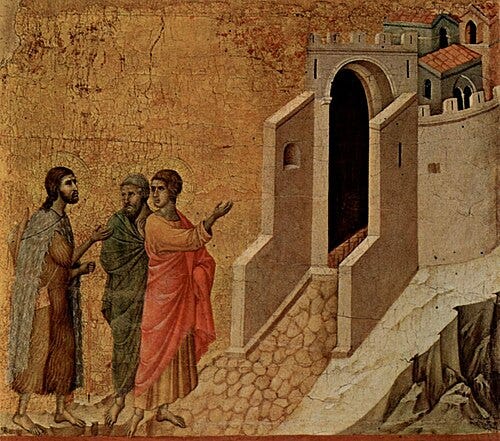
The story of the Road to Emmaus follows the same pattern.4 The disciples encounter Christ on the way, and while he opens the scriptures to their understanding, they still only recognize him in the breaking of the bread. Even with the explanation of the Scriptures in a Christ-centered light, it is only after a direct encounter with the risen Christ (eucharistically in this case), that the story becomes clear. Paul, in his second letter to the Corinthians, phrases this as a “veil” being lifted:
Indeed, to this very day, when they hear the reading of the old covenant, the same veil is still there; it is not unveiled since in Christ it is set aside. 15 Indeed, to this very day whenever Moses is read, a veil lies over their minds,16 but when one turns to the Lord, the veil is removed. 17 Now the Lord is the Spirit, and where the Spirit of the Lord is, there is freedom. 18 And all of us, with unveiled faces, seeing the glory of the Lord as though reflected in a mirror, are being transformed into the same image from one degree of glory to another, for this comes from the Lord, the Spirit.
(Incidentally, the word in Greek for “Spirit” is the same word as “breath,” so the idea of active, vivifying breath fits this imagery perfectly).
If it is the Spirit that removes the veil from the scriptures and allows us to see Christ clearly within them, then the resurrected Christ is the first principle of reading the scriptures as Scripture, not a narrative conclusion of the text. None of the Gospels are written as if your expectations are supposed to match the narrative chronology; you are not meant to read early chapters of Matthew and wonder if this Jesus guy is going to end up being the Messiah. No, from page one of every Gospel, we are reading about the Crucified and Risen One, even before those events happen in the respective narratives.5 So when the Old Testament is invoked, and a prophecy is declared fulfilled, it is always talking about the Crucified and Risen One, even in contexts that narratively precede Christ’s passion. And this is, in fact, the only way to even make sense of some of the “fulfillments,” considering many of the prophecies invoked are not, in their original context, predictive at all. Let’s illustrate this with a quick case study:
Case Study: Matthew’s use of Hosea
In the second chapter of Matthew, we read about Jesus and his family fleeing to Egypt until King Herod’s death.
14 Then Joseph got up, took the child and his mother by night, and went to Egypt 15 and remained there until the death of Herod. This was to fulfill what had been spoken by the Lord through the prophet, “Out of Egypt I have called my son.”
Matthew clearly tells us that this is a fulfillment of prophecy, and the passage he is referencing can be found in Hosea chapter 11:
When Israel was a child, I loved him,
and out of Egypt I called my son.
Now, ask yourself objectively: is this a prediction about the future? If you were a Jewish reader in the year 100 BC reading this, what would you think this line means? God clearly identifies who he is talking about (Israel), and calling this “son” out of Egypt certainly sounds like the Exodus. The following line about Israel “offering incense to idols” aligns with the narrative we find in the post-Exodus period, but we don’t even need to get that granular. There is simply no reasonable case to be made that anyone reading this passage in its original context would think to themselves, “boy, I wonder when this future prediction is going to come true.” The entire passage is in the past tense!6
So clearly, when Matthew describes this as a “fulfillment” of prophecy, he does not and, in fact, cannot mean this is the payoff to a predictive setup. The “fulfillment” of prophecy does not refer to the accuracy of fortunetelling; it’s something deeper, more teleological, indeed more theological. Matthew is pointing out that Israel’s telos is fulfilled in Christ, not that Hosea was intentionally writing about a future Nazarene named Jesus. And I would argue that all the “fulfilled” prophecies in the New Testament match this pattern, not the colloquial understanding of predictions coming true. It may strike against our conventional sensibilities, but what makes best sense of the text is that the evangelists start with Christ and then use Him to make sense of the Old Testament, rather than starting with vague Old Testament predictions that suddenly make sense in Christ.7 This is the pattern we see modeled in encounters with Christ, which open people’s minds to understand the scriptures, and it explains how verses that in their original context were not predictive, messianic, or future-oriented can rightly be understood as all three.
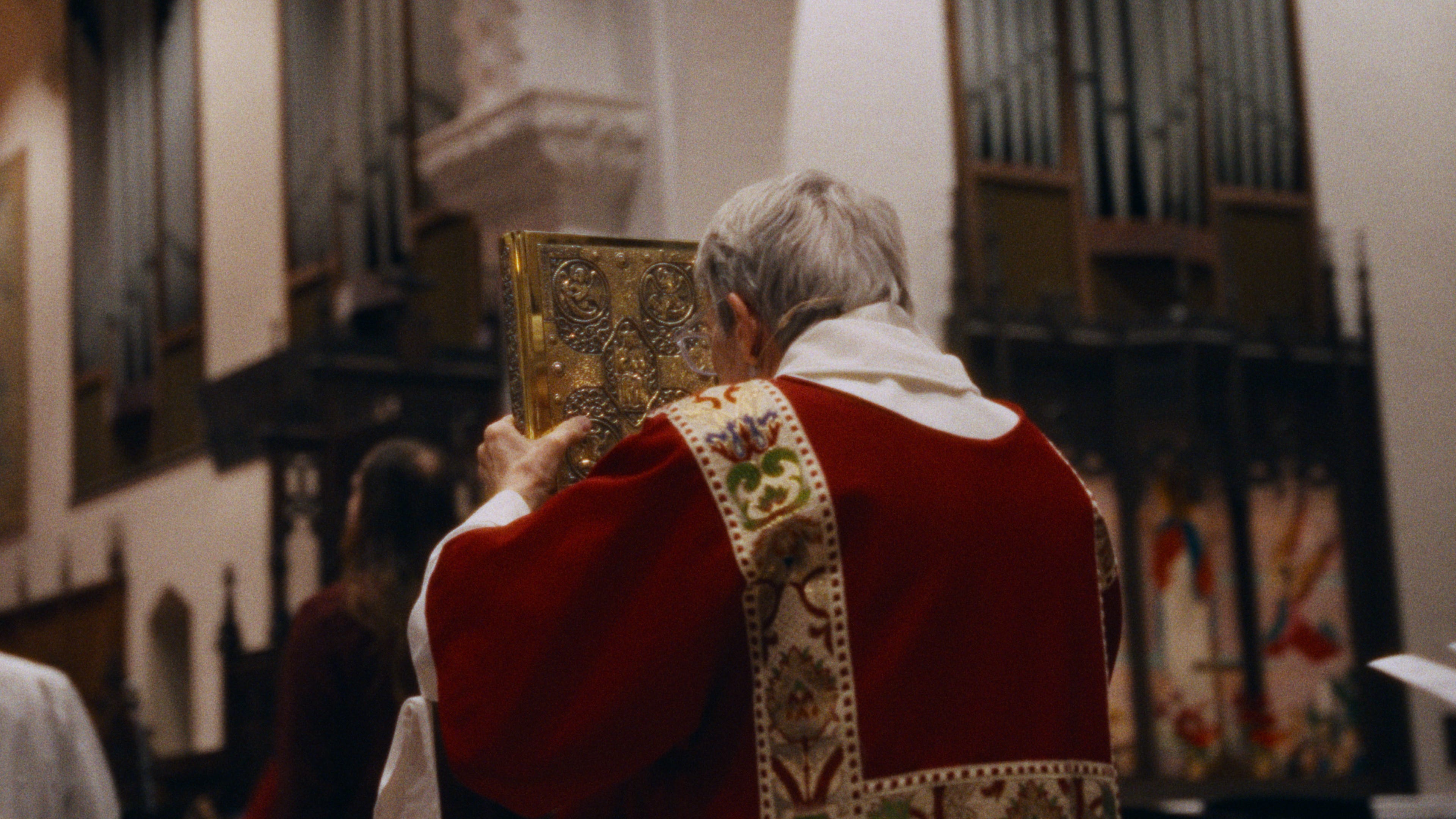
This means that to read the Old Testament, or any of the Bible for that matter, as Christian Scripture only works when you begin with the risen Christ.8 A Jewish rabbi reading the Old Testament through a Talmudic lens is not reading it as Scripture (in the Christian sense), nor is the historian doing a historical-critical analysis of a story in Genesis or Samuel. They are not meaningfully reading the “inspired” Word because the Spirit is not vivifying their reading, and they are not seeing Christ because they are not beginning from a first principle that makes him available as an option. The inspiration of Scripture comes as much from its reading as from its writing, and that is why I would argue that the liturgical context is one of the only ones where calling ALL Scripture “the Word of the Lord” makes any sense.9 When Scripture is read in church, it is not for historical study or critical analysis; its express purpose is to provide the foundation from which the gospel can be expounded. Homiletic practice is a great example of this: a good sermon draws from these passages and derives a gospel message from them, but even the sermon is just another prefiguration of what is to come. The whole Sunday, at least for us Anglicans (and I know Catholic, Lutheran, and other traditions are structured similarly), builds to the Eucharist, and it is the Eucharist in which all that is prefigured comes into its fullness.
The Eucharist is a tangible taste of the Age to come, a localized inbreaking of New Creation into the present order, and it is in the vicinity of this direct encounter with Christ that mundane things like bread and wine can be transfigured into divine instruments of grace. The promise of the Road to Emmaus is that Christ can be found on the way and met in faces unrecognized, but it is the breaking of the bread where we are promised to know Him as the Crucified and Risen One, and this is why the Eucharistic meal, for all the endless debates about the details of its cosmic mystery, has been the central focus of Christian ritual since the earliest days of the Church.10 And this is right, because all elements of a church service, whether a sociologically eclectic house gathering in Corinth or a smells-and-bells Catholic Mass, make fullest sense in their proximity to a direct encounter with Christ. This is why Christianity has always been a communal movement, and why we are so mistaken in the modern West when we reduce it to some sort of private, individualistic practice. Christ’s body is available in the Eucharist (which is always a shared meal) and in the corporate body: the people in the pews beside us. These settings fulfill the necessary prerequisite for any Bible passage to function as “the Word of the Lord,” because within that intentional context, that is what all Scripture IS.
Now, let me be clear because I got a bit carried away with my mysticism there: I am not saying there is some quantifiable process by which the true inspired text is magically “activated,” nor am I saying that the liturgical context I am describing is the ONLY place where the scriptures can be read as Scripture, nor am I saying that the “encounter” with the risen Christ must be some sensational, emotional, or discernibly supernatural experience, and in fact I think a lot of harm is done by chasing those sorts of spiritual highs. I lack the terminology to aptly describe my methodology, but all I’m trying to convey (I think) is that context determines meaning, meaning drives experience, and experience produces character. The liturgical context of the Church (or a devotional context derived from that practice) is what gives the “Scriptural” meaning to “the Bible,” the meaning drawn from that understanding gives us the experience of encounter (in all the many many ways that happens on the individual level, from mundane to sensational to everything in between), and regular encounter shapes our Christian character, again not by magic, but the way any good habit is formed: discipline, repetition, and intentional practice. There is a transcendent component to Christian ritual in its metaphysical claims about truly encountering Christ in the Eucharist, but I think the frequently debated details of this (real presence, transubstantiation, memorialism, etc) are of secondary importance to the simple truth of the shaping that comes from the intentionality, community, and spiritual seeking which produce the context of Eucharistic practice.
And as such, encountering Christ should be a regular occurrence. Daily bread sustains. Christ as the bread of life is a metaphysical claim as much as a theological one; our existence is predicated upon God’s continual sustenance, an eternal donation of being from the source of all Being. To accept Christ as our daily bread is to acknowledge what truly sustains us; just as food nourishes our body, the God-man, in, through, and for whom all things were made, sustains our very reality. Again, this is not just metaphor: Christ uniting himself bodily to humanity, God truly enfleshing himself in creation, is what unites both with God. Eternity is brought into temporality so that temporal might endure eternally. Or as so many of the Fathers say in different ways: Christ becomes what we are so that we might become what He Is. That is the comfort of the incarnation, the promise of the resurrection, and the glory of their meeting in the Eucharistic encounter.
So to seek some path towards a conclusion,11 let’s try to summarize:
“Inspiration” is a term of application, as much, if not more so, than it is a term of origin. The “God-breathed” Scriptures come to life by the active indwelling of the Holy Spirit in liturgical and devotional contexts. The Bible is not truly “inspired” just sitting on the shelf, and a dispassionate, analytical reading of a book of the Bible is not synonymous with “reading Scripture.”
The risen Christ is the first principle of Christian theology. As the New Testament authors and characters show us, a Christian reading of the Bible only works downwind of an “encounter” with Christ. And from this we also conclude that:
“Fulfillment” is theological, not predictive. Christ’s “fulfillment” of the Scriptures is not an obvious payoff to a future-oriented setup, but a re-understanding of old things in the revelatory light of new knowledge.12 Just as the intentionality of the Eucharist allows us to see bread and wine as something more, beginning with a Christotelic presupposition is what opens the Scriptures and allows us to read Christ where, without his revelatory light, he would not be visible. And finally:
The Eucharist is the central Christian ritual because it is the necessary first principle of theology. Only after a direct encounter with the risen Christ can our eyes truly be opened and the Scriptures become clear. All theology follows from the starting point of the Christian kerygma (“proclamation”), summarized by Paul in 1 Corinthians 15, and because of this, the communal response of Christ’s Body sharing the common table has been the locus of Christian worship since the first days of the Church.13
There is so much more that could be said about the implications all of these conclusions have on the nature of the church, the function of liturgy, and a dozen other subjects besides. I will expand on the challenge of scriptural chronology and some implications of “canon” in my next article, and the rest I may return to in future work. But if you’ve read this far, I’d like to end this one by soliciting your feedback. Does what I’ve expressed here align with your own view of these subjects? Challenge it? Something in between? Or skipping my digressions entirely, in what sense do you believe the Bible to be (or not be) “The Word of the Lord?”
It’s the negative potentiality of an otherwise good thing. The rhythm afforded by the Daily Office of the BCP is almost unparalleled in quality throughout the wider Christian world. I absolutely love the Anglican liturgy.
Some of you may be more familiar with “The Lord be with you,” “and also with you,” which was changed to “and with your spirit” in both Catholicism and Anglicanism a few years back. But contrary to popular opinion, this was actually a change back to the original language, in all the older editions of the prayer book (from 1928 on back to the original in 1549) “and withe thy spirite” is the standard response.
I chose not to get into too much detail about the particularities of 2 Timothy 3:16, such as how the beginning, “all scripture is inspired by God, and is…” could just as rightly be translated: “Every scripture inspired by God is,” but the “breathed into” reading makes better sense of the surrounding context, as nothing in the larger passage seems to have anything whatsoever to do with authorship. According to 2 Timothy, the “inspiration” of scripture is relevant to its use, not its origin.
For the record, I did not recognize this pattern on my own, as I’ve stated multiple times on here I’m extremely influenced by the work of John Behr, and I’m certain much of what I’m saying here paraphrases conclusions his work led me to over the years. His book In Accordance With the Scriptures: The Shape of Christian Theology is probably a good starting point if you want to dig deeper.
And each Gospel is the same Gospel, just a different telling. It is not “the Gospel of Matthew” or “the exclusive gospel told only correctly by Luke,” each Gospel is the same Gospel “according to” a different author.
And since we know Matthew is working from Greek translations, you might wonder if perhaps the Septuagint has a different reading, and it does, but interestingly, Matthew’s is much closer to the Hebrew. The Septuagint version (as we have it) of Hosea 11:1 reads: “Early in the morning were they cast off, the king of Israel has been cast off: for Israel is a child, and I loved him, and out of Egypt have I called his children.”
Isaiah 7:14 is one of the most famous instances of this, where, in its original context, it is not about the future, not about a virgin, and not even about the Messiah. Various Jewish movements in the first century and before had all sorts of passages they’d read as messianic, but I have not been able to find a single one before Matthew that invokes Isaiah 7:14 messianically. Best I can tell, he was innovative in doing so, and I think his use of it only makes sense by way of the method I’m describing here. I will expand on this specific example in my next article.
As Behr says: “What is at issue here is the presupposition, or hypothesis, by which one finds meaning from these texts, and ultimately, as with all first principles, this is based on faith.” I realize that it seems counterintuitive to approach faith in Jesus as a first principle rather than as a theological conclusion, but I do think that is, at least historically speaking, that is the Christian order of these things (not to say conclusions about Jesus cannot be the result of logic, history, reason, etc, I’m mostly talking about the order of theological reasoning here).
I don’t really have room in this article for a digression on the difference between “The Word of the Lord” and “The Word of God,” which, while the Lord Himself is God, I do believe are meaningfully different terms, especially if we’re co-opting Paul’s distinctive use of “Lord,” but alas, maybe another time…
An evergreen reminder that Paul, our earliest historical source on Christianity, describes the Eucharist as something passed down to him as tradition, meaning it was already established in those short years before he joined the movement.
Can you tell that I don’t really outline these articles?
Incidentally, of all the popular apologetic arguments I see making the rounds on social media, the “Jesus fulfilled x amount of prophecies and that is statistically impossible” may be one of the absolute worst. I don’t think there’s any good argument that most of the passages he fulfilled are even predictive in their original contexts and that to assert so misunderstands what fulfillment even means. But even if we granted that, the authors of the Gospels clearly knew the Old Testament, so why would they not just write their narrative in light of these prophecies? Asserting these fulfillments as some sort of material “proof” utterly bypasses the bias of the authors mediating these fulfillments to us, and that logic would never hold up in a different religious context.
Again, I’m not arguing the Eucharist is the only way to encounter the risen Christ, but it is a place where you are guaranteed to do so.
This really does speak to the difference between an active participant of Christianity vs a fairweather Jesus fan who "can worship in my heart", never goes to Church, never does any kind of outreach or charitable service and chooses the hate and greed that is preached from the pulpit of Fox News.