

Lately, I’ve seen a particular sentiment surfacing again and again on social media. I do not know who Jim Palmer is, but his recent post that appeared on my Facebook feed captures the pattern well enough to serve as a working example:
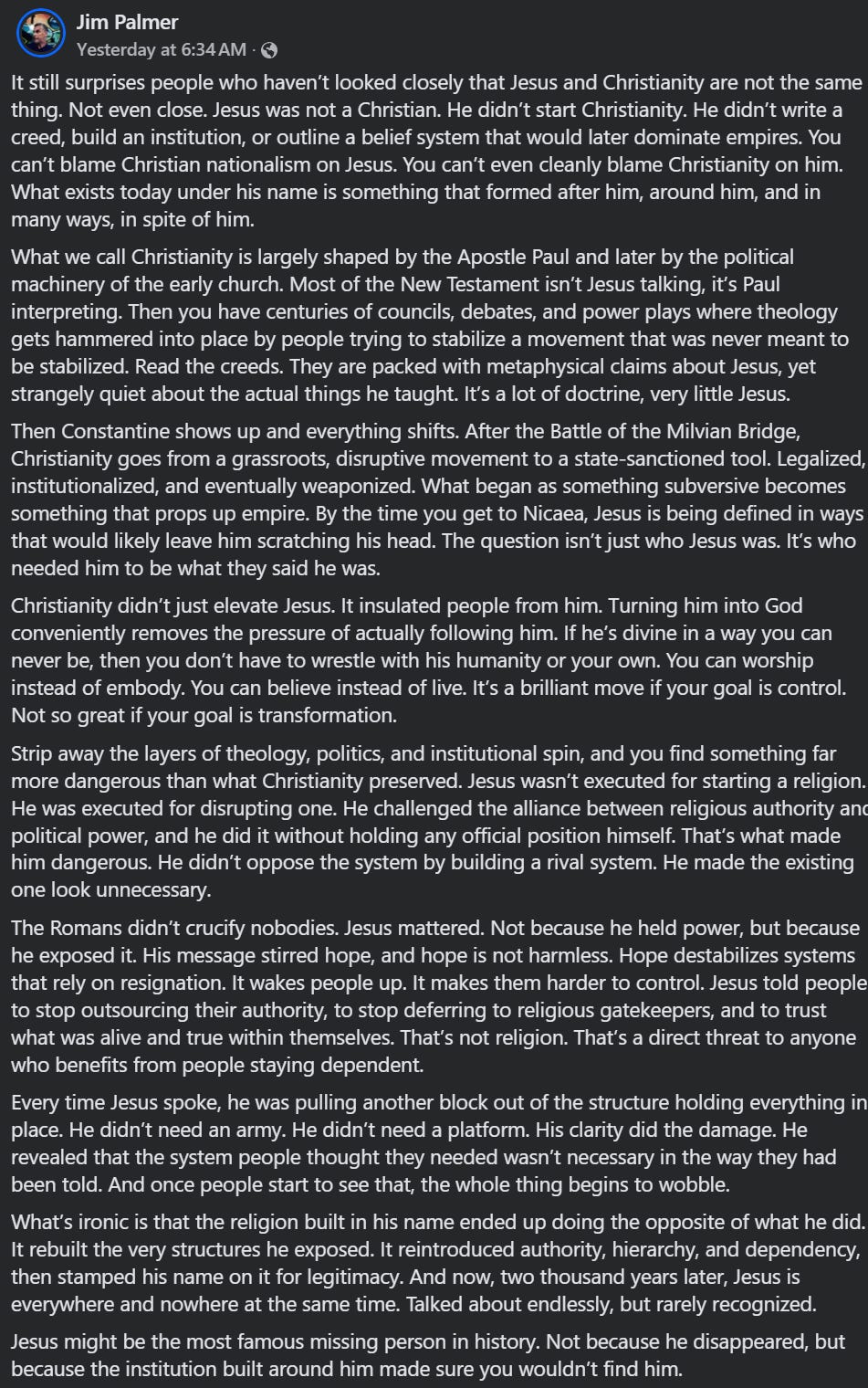
I know the “Paul really founded Christianity” or “the institution of the Church obfuscates Jesus” idea is nothing new, and while I appreciate the rhetorical aim of getting back to the core of Jesus’ ministry, I think posts like this are misguided in a few critical ways. With no disrespect intended towards Mr. Palmer, let’s take his claims paragraph by paragraph:
“Jesus was not a Christian. He did not start Christianity…”
This is only half true. While it’s correct to say that nothing in the Bible or history tells us Jesus wrote a charter for a brand new religion called Christianity, he most certainly did found a movement. Historians can and will continue to argue exactly how independent it was supposed to be,1 but there’s ample evidence that his followers understood themselves as participating in something distinct from the established institutions of his day. And while the name “Christian” began to be used quite early in Antioch (according to the author of Acts), Christians before that simply styled themselves as followers of “The Way.” I think the inclination to distance this movement from religiosity is a bit anachronistic. People want Christ’s morals to stand alone, absent from any moral system or anything resembling an institution, but the truth is that Christ prescribed morals and structures just like any other religious teacher (albeit in ways that certainly challenged conventional understandings of his day). He was a Jewish rabbi, a unique one to be sure, but his teaching methods were not entirely alien to his fellow rabbis. The desire to free Jesus from what is seen as corruptive institutionalism is admirable in spirit (especially when done in opposition to modern evils like Christian Nationalism), but rather misguided in practice.
“What we call Christianity is largely shaped by the Apostle Paul and later by the political machinery of the early church. Most of the New Testament isn’t Jesus talking, it’s Paul interpreting.
Here is where the oversimplification of this position is most apparent. For starters, ALL of the New Testament is someone interpreting. To set Paul aside as uniquely “interpretive,” as if the four Gospels are not, is to misunderstand what the Gospels are. Furthermore, we must always remember that Paul is our earliest Christian source. While the reading order of the New Testament takes us through the Gospels before we get to his epistles, Paul’s letters precede even the earliest Gospel by a few decades. And given Paul’s obvious influence in the early church, it’s hard to separate the Gospels from the reach of Pauline theology, even if there is mixed opinion on whether or not the Evangelists included Paul amongst their literary sources.2
But again, even if we cut Paul out of the equation, the Gospels themselves are interpretive. All one needs to demonstrate this is to read all four in a row and observe how Matthew and Luke make interpretive changes to the same stories found in Mark, or how John completely re-arranges (and expands) the order of events in Jesus’ ministry, all the way down to having him be crucified on an entirely different day of the week to make a theological point. If that’s not a theologically “interpretative” choice, I don’t know what to call it. Even if the Gospels contain authentic sayings of Jesus (which I believe they most certainly do), those sayings are transmitted to us within an interpretive narrative, with their meaning frequently explicated by each author.
Also, the “political machinery” of the early Church feels like quite the overstatement. Paul was, best we can tell, one of the most influential Christian leaders of his day, yet even he had to contend with the influence of unnamed “super apostles,” or named rivals like Apollos, Peter, and James. The early church was hardly a centralized power, internally or otherwise, and this remained the case for hundreds of years, even as more formal systems of clerical hierarchy developed. The idea of a top-down institutional oppression of free expression in the first few centuries is anachronistic at best and a caricature at worst.
Then you have centuries of councils, debates, and power plays where theology gets hammered into place by people trying to stabilize a movement that was never meant to be stabilized. Read the creeds. They are packed with metaphysical claims about Jesus, yet strangely quiet about the actual things he taught. It’s a lot of doctrine, very little Jesus.”
I have read the creeds. I don’t think they are as “stable” as this characterization implies. In fact, it’s rather telling that Christians as far apart on the theological spectrum as Pentecostals, Baptists, Catholics, and Eastern Orthodox can all (more or less) affirm the creeds as written. The early creeds are incredibly minimal and prioritize affirmations of faith over exact expositions detailing the full extent of said affirmations. I also don’t think calling them “strangely quiet” about the things Jesus taught is fair. The creeds were not designed to replace the content of the Gospels, nor solely to summarize the moral dimensions of Jesus’ teachings. The metaphysical claims “packed” into the creed are claims about Jesus, not a replacement for what he taught. It doesn’t have to be one or the other.
“Then Constantine shows up and everything shifts. After the Battle of the Milvian Bridge, Christianity goes from a grassroots, disruptive movement to a state-sanctioned tool. Legalized, institutionalized, and eventually weaponized. What began as something subversive becomes something that props up empire. By the time you get to Nicaea, Jesus is being defined in ways that would likely leave him scratching his head. The question isn’t just who Jesus was. It’s who needed him to be what they said he was.”
This contains some truth, but again, the oversimplification is strong here. For one, while Constantine legalized Christianity, it wasn’t until decades later that Emperor Theodosius would make it the official religion of the Roman Empire, which is where it is more fair to claim it became state-sanctioned/institutionalized and eventually weaponized. It’s entirely reasonable to contend that the adoption of Christianity as the faith of the empire began a process of erosion and weaponization, leading to many distortions of Christianity that persist to this day. I myself have criticized on several occasions how it only took five years after its adoption as the state religion for the first execution of heretics to be carried out. However, to blame all of this on Constantine, to treat it as instantaneous, or to imply that Nicaea primarily served the interests of empire, these are all misguided notions. For one, while Nicaea and its follow-up ended up condemning Arianism, it’s not at all clear that Arianism was anything but the majority belief of Christians in the Empire. Constantine himself, despite his support for Nicene orthodoxy, appears to have softened on Arianism even after it was formally decried at Nicaea, choosing political expedience over doctrinal solidity. The line drawn by Nicaea did not serve the interests of the empire; if anything, enforcing a doctrinal line in the theological sand would have been divisive, not conducive to the wielding of power. So the implication that Jesus “needed to be what they said he was” just doesn’t really map onto the political or theological reality of that time period.
“Christianity didn’t just elevate Jesus. It insulated people from him. Turning him into God conveniently removes the pressure of actually following him. If he’s divine in a way you can never be, then you don’t have to wrestle with his humanity or your own. You can worship instead of embody. You can believe instead of live. It’s a brilliant move if your goal is control. Not so great if your goal is transformation.”
With respect, this is one of those claims that only sounds deep until you think about it for more than a few seconds. The idea that difficult commands from Jesus like: “be perfect as your heavenly Father is perfect,” are somehow mollified by Christ being God makes no sense. It’s not as if the moral invocations to follow Christ are invalidated by his divinity. Additionally, this claim implies Christ’s divinity was added at Nicaea, but if you read Paul (again, our earliest source) or any of the Gospels, Christ’s divinity is obviously there from the very beginning.3 And in fact, the high call of humanity to be moral in the way Jesus was is predicated upon that very divinity! If the fullness of God can dwell in a human being, then the calling to “wrestle with our humanity” is nothing less than a divine calling.
Also, this claim makes it clear that this author does not understand Christianity very well. Christians do not believe Christ is “divine in a way we can never be,” they believe that God became man precisely so that man could become divine. Claiming Christ’s divinity allows us to “worship instead of embody” is the opposite of the message found in the New Testament or early church writers. The New Testament explicitly talks about how to “believe” is demonstrated by how you live. Not to mention, the implication made in this post is that Jesus must be either divine or human, but the question being argued in most of these cases was how he could be both. The radical Christian claim is that Jesus is entirely human and entirely divine. Christian unity in the body of Christ is how Christians are able to pray to God as “our” Father. Nicene Trinitarianism isn’t an abstract claim about God over there, shoving Jesus up into the clouds with sky-daddy-Zeus-God. Nicene Trinitarianism affirms the Johannine language that Christ desires his disciples to know the Father as he knows the Father. Christians, therefore, do not (at least in prayers like the Lord’s Prayer) pray to the Trinity, but in the Trinity, praying to the Father in the place of the Son by the working and unifying power of the Spirit. Creation is made in and through Christ, and it is in and through Christ that creation participates in the eternal life and love of God. So nothing about this is a “brilliant move,” even in the conspiratorial fiction where the goal is control, because the claims of Christ’s divinity cannot meaningfully be said to separate us from God; those claims are the very means by which Christians claim God unites us to himself. This reductionist view claiming a desire for “control” is not a scathing critique of institutional religious power; it’s not even a very good strawman.
“Strip away the layers of theology, politics, and institutional spin, and you find something far more dangerous than what Christianity preserved. Jesus wasn’t executed for starting a religion. He was executed for disrupting one. He challenged the alliance between religious authority and political power, and he did it without holding any official position himself. That’s what made him dangerous. He didn’t oppose the system by building a rival system. He made the existing one look unnecessary.”
But he did build a rival system. His entire challenge to the existing system was an alternate “Way.” Even if one doesn’t characterize a “movement” as a “system,” the functional overlap looks like a circle.
“The Romans didn’t crucify nobodies. Jesus mattered.”
This, maybe more than any other part of the post, demonstrates the ignorance at play here. The Romans absolutely crucified nobodies. Crucifixion was the lowest form of capital punishment, reserved exclusively for nobodies. Crucifixion was how the Romans disposed of slaves and vagabonds. Important people, citizens, and criminals of status received different, less humiliating deaths. Jesus absolutely mattered, but he was killed in the manner of someone who didn’t, which is why the claim of a crucified messiah was such a scandal to the first-century mind.
“Jesus told people to stop outsourcing their authority, to stop deferring to religious gatekeepers, and to trust what was alive and true within themselves. That’s not religion. That’s a direct threat to anyone who benefits from people staying dependent.”
Jesus did do more appealing to the inner conscience than some Christians are comfortable with; however, I think that to “trust what was alive and true within themselves” is overstated. It is strangely common to find Jesus reduced to a sort of New Age hippie, whose true teachings are vague spiritualisms about inner peace and Buddhist calm. But you don’t have to be a Christian to understand that this is just plain wrong. Jesus, whatever else he was, existed in a specific vein of apocalyptic Jewish messianism. There is no historically accurate way to reduce what he taught down to the vagaries of “what was alive and true within themselves.” In fact, stripped of the theological context Christianity provides, the “historical Jesus” might be viewed by moderns as closer to that guy on the street corner shouting about the end of the world than your charming yoga instructor. The desire for Jesus to be a peace-and-love guru is doubtless well-intentioned, but it simply cannot be sustained without ignorance.
“Every time Jesus spoke, he was pulling another block out of the structure holding everything in place. He didn’t need an army. He didn’t need a platform. His clarity did the damage. He revealed that the system people thought they needed wasn’t necessary in the way they had been told. And once people start to see that, the whole thing begins to wobble.”
Again, this doesn’t read like someone who has actually read the words of Jesus, it reads like someone who has sort of heard things about Jesus. Jesus challenged the systems of his day, but he wasn’t just an anti-system for its own sake, freedom-for-the-masses guy. He had a specific and clearly stated religious agenda. He didn’t say “ignore the religious institutions and follow your truth,” he said, “I AM those institutions, follow ME.”
“What’s ironic is that the religion built in his name ended up doing the opposite of what he did. It rebuilt the very structures he exposed. It reintroduced authority, hierarchy, and dependency, then stamped his name on it for legitimacy. And now, two thousand years later, Jesus is everywhere and nowhere at the same time. Talked about endlessly, but rarely recognized.”
Now, for the most part, this claim is true. The Church has instituted hierarchy, misused authority, and misappropriated the name of Jesus for legitimacy. Horrific evils are justified in Christ’s name by our leaders today, and that is not a unique occurrence. But given that this claim is predicated upon all the reductionism that precedes it, I hesitate to affirm even the parts I agree with. My impression is that the “real” Jesus this author is desperate for people to see is as much a fiction as the Jesus he is denouncing.
“Jesus might be the most famous missing person in history. Not because he disappeared, but because the institution built around him made sure you wouldn’t find him.”
Lastly, I would like to know where people can find this missing Jesus. Every real detail we know about his teachings is preserved in Christian sources. We have the same access to ancient manuscripts that the church does; we can go and look at the original Greek and see what it says. For all its many flaws and historical atrocities, the historical Church is our only preserver of ANY version of Jesus, and if you want to claim this institution corrupted him (insofar as the Church can ever, in any historical era, be spoken of as a monolith), you must appeal to facts from that very institution to do so.
In the end, I understand and even appreciate what people like Mr. Palmer are attempting to do here. I share his desire to oppose the weaponization of the faith, and especially to combat the perverse lies about Christ that undergird repulsive movements like Christian Nationalism. But it is useless to combat lies about Christ with lies about Christ. In attempting to free Jesus from institutional corruption, these kinds of posts turn him into something completely alien, and ironically, in their efforts to liberate him from the confines of distant deity, they re-inter him within an equally false prison, propping him up to be admired as an idol of anachronism.
Was he continuing something founded by John the Baptist? Spinning off a new iteration of Judaism? Reforming or replacing both?
Markan theology is decidedly Pauline, Matthew less so.
People frequently misunderstand modern scholarship on this point. There is absolutely contention among scholars about the precise nature of Christ’s divinity as intended by the original authors. Whether or not the “historical” Jesus claimed to be God in the fullest sense of the word is still hotly debated; however, the notion that Jesus was understood to be in some sense divine, or at the very least, a mediating agent of the divine, is less controversial. There really is no version of Jesus in antiquity, either in Christian or non-Christian sources, without some sort of divine power. So this author’s implication that Nicaea introduced Jesus’ divinity is flatly wrong.
“Turning him into God conveniently removes the pressure of actually following him” had me SIT UP lol. Him being fully God (and fully man) is the reason we follow Him…. And “If he’s divine in a way you can never be, then you don’t have to wrestle with his humanity or your own” someone tell this guy about theosis!
Anyways loved your responses. It always bugs me when people who aren’t Christians or have limited knowledge about Christianity talk like they know what’s up. But you were so charitable :)
I’ve read a lot of Jim Palmer over the last couple years. He is obviously very intelligent and he was for many years a fundamentalist pastor in a mega-church. This suggests that he does indeed know Scripture and church history. I have, however, always come away from his writing as being too glib, and too journalistic, as opposed to theological. It seems as well that he shifts his attitude from essay to essay depending on his intended audience.
Your comments on his work are wonderfully clear and reflective of a deep faith. Thank you
You (and I, perhaps) might get pushback from Jim and/or his supporters for this. Just saying.