


I’m a sucker for classic fairy tales. While I love more complicated iterations of the fantasy genre, from the gruesome realism of Game of Thrones to the feudalistic, sci-fi-infused world of Dune, there’s something about a good old-fashioned idealistic adventure where a noble knight crosses blades with a fearsome foe to save a village/princess/his honor that speaks to something primal within me, no matter how old I grow. The optimism required to enjoy a story where the good guys win and evil is punished shines with an almost childlike luster in a cynical world, and I sometimes wish those in my line of work were a little more accepting of such tales.
An advantage of these simpler stories is moral clarity. If I’m telling you the story of a brave knight called to rid a village of an oppressive dragon, I don’t need to justify why the dragon lusts for gold or hungers for virginal sacrifices. Dragons are dragons, and everyone knows that dragons hoard treasure and must be ritually propitiated to conciliate their fiery wrath. Nor do I have to justify why the knight feels he has the right to confront such an enemy and slay him. The moral obviousness of freeing innocent villagers from the terror of such oppression is exactly that: obvious. Nobody looks at those stories and says, “Well, maybe the dragon has a good reason to extract all that wealth from the economy and hoard it in a cave. Maybe, through hard work, the dragon earned the right to demand the death of innocent maidens to slake his monstrous appetite.”
That level of assuredness can be dangerous in the real world. Nothing fuels self-righteousness like moral certainty. Yet now and again, perhaps we need the indignant shove of the morally assured to shake us out of our hesitancy to call things what they are, and that is exactly what we find in the homilies of the 4th-century church father St. Basil the Great.1 While the Bible is not clear on many things, one of the few things it is almost entirely consistent about is the condemnation of greed. This invective takes a few forms, from an excessive focus on economic disparity and the exploitation of the vulnerable in the Old Testament to a near-blanket condemnation of wealth itself in the New Testament.2 St. Basil repeats these condemnations without scruples, tearing into the wealthy of his day with calls to action that would make Bernie Sanders blush. Basil does not say the rich ought to give some money to the poor out of the charitable goodness of their bleeding hearts; he says those who do not do so are thieves:
“Is not the person who strips another of clothing called a theif? And those who do not clothe the naked when they have the power to do so, should they not be called the same?”3
This apparently was not severe enough for Basil, as he goes on to call them murderers:
“Whoever has the ability to remedy the suffering of others, but chooses rather to withhold aid out of selfish motives, may properly be judged the equivalent of a murderer.”4
We’re very accustomed, at least in the United States, to compartmentalizing our morals. We Christians claim to believe in generosity, in love of neighbor, in caring for the vulnerable, but we set limits on these things at the interpersonal level. If the government does it, it’s socialism, and socialism is bad, because the government should never compel our morality (except when it comes to abortion, theft, the right to self-defense, murder, etc).5 I lack the expertise (and frankly, interest) to make sweeping claims about the economic realities of capitalism vs socialism vs any other system; however, I will say that the more I read about historical Christianity, especially the early days of the church, the more bizarre the marriage between American capitalism and American Christianity looks. We have chosen, as a culture, to completely eschew the Bible’s endless condemnations of greed and gain, choosing instead to idolize materialist systems where the accrual of wealth is celebrated as moral victory and, in the more toxic manifestations of this phenomenon, prop up pastors who openly pilfer their congregations for private jets and designer sneakers.

One fun fact most Christians do not know about Christian history is the long-standing hostility to usury in all its forms. Almost ubiquitously, the early and medieval church stood opposed to charging interest on loans, with increasing strictness over time (the clergy was forbidden from doing so at the council of Nicaea, the Laity received the same charge at the Council of Carthage, and by the time you get to the 3rd, 4th, and 5th Lateran councils, the practice itself is unequivocally condemned as inherently sinful).6 St. Basil is an early expounder of this principle, stating in a homily aptly titled Against Those Who Lend at Interest:
“In truth it is the height of inhumanity that those who do not have enough even for basic necessities should be compelled to seek a loan in order to survive, while others, not being satisfied with the return of the principal, should turn the misfortune of the poor to their own advantage and reap a bountiful harvest.”
Basil is so opposed to the practice that he spends several pages of the homily begging the poor amongst his listeners to stay in their downtrodden circumstances rather than subject themselves to the injustice of predatory loans.
“Listen, you rich, to the kind of counsel I am giving to the poor on account of your inhumanity: to remain in dreadful circumstances, rather than accepting the assistance offered by loans at interest. But if you took the Lord at his word, would there be any reason for such words? What is the counsel of the Master? ‘Lend to those from whom you do not hope to recieve again.’”
Again, the moral clarity on display is downright refreshing. Basil is basically saying, “If we Christians just took Jesus at his word and did what he said, we wouldn’t have this problem in the first place.” How convictingly simple is that? How damning is it that his words, written 1600 years ago, are just as relevant for us today? How much ink and effort has been spilled justifying our own greed, explaining why Jesus can’t have meant the thing he plainly said? Basil doesn’t let up:
“As it is, the interest you receive back shows every characteristic of extreme misanthropy. You profit from misery, you extract gain from tears, you oppress the naked, you beat down the starving. Mercy is nowhere to be found; there is no thought of kinship with those who suffer. And yet you call such gains the benefits of philanthropy! ‘Woe to those who call the bitter sweet and the sweet bitter,’ and to those who call misanthropy by the name of philanthropy.”
A common talking point in popular discourse is the notion that billionaires should not exist. The calculus for this assertion usually rests upon the exploitative methods by which that much wealth is accrued, but given Basil’s appraisal7 of the rich, I wonder if how their wealth was acquired would even be relevant to him. Surely, exploiting the working class is something he would condemn, but given his absolute and uncompromising certainty in the need for Christians to oppose economic disparity, I wager he would take it a step further. He would not do as we so often do today and insist on a meager offering of charitable giving out of their excess; I think he would lump billionaires in with murderers. Which, at this present moment, would not be hard to do. Imagine someone of Basil’s lucidity assessing a figure like Elon Musk, the world’s first trillionaire, whose most notable contributions to society over the last few years have been reshaping popular discourse in increasingly fraught and divisive terms, amplifying conspiracists and nazi-adjacent (or sometimes just nazi) figures almost daily, and leading an organization that is already personally responsible for hundreds of thousands of needless deaths with millions more to come. And the fact that Musk did most of these things primarily for the memes rather than for direct financial gain takes these actions from the usual category of reckless evil in service of self-enrichment to a borderline (if not outright) demonic level of evil in service of evil as such. Feeding humanitarian services “to the wood chipper,” to placate savage morons in service of baseless nonsense crosses the line from man to monster, and I wish I had 1/10th of Basil’s eloquence or sagacity in decrying it.
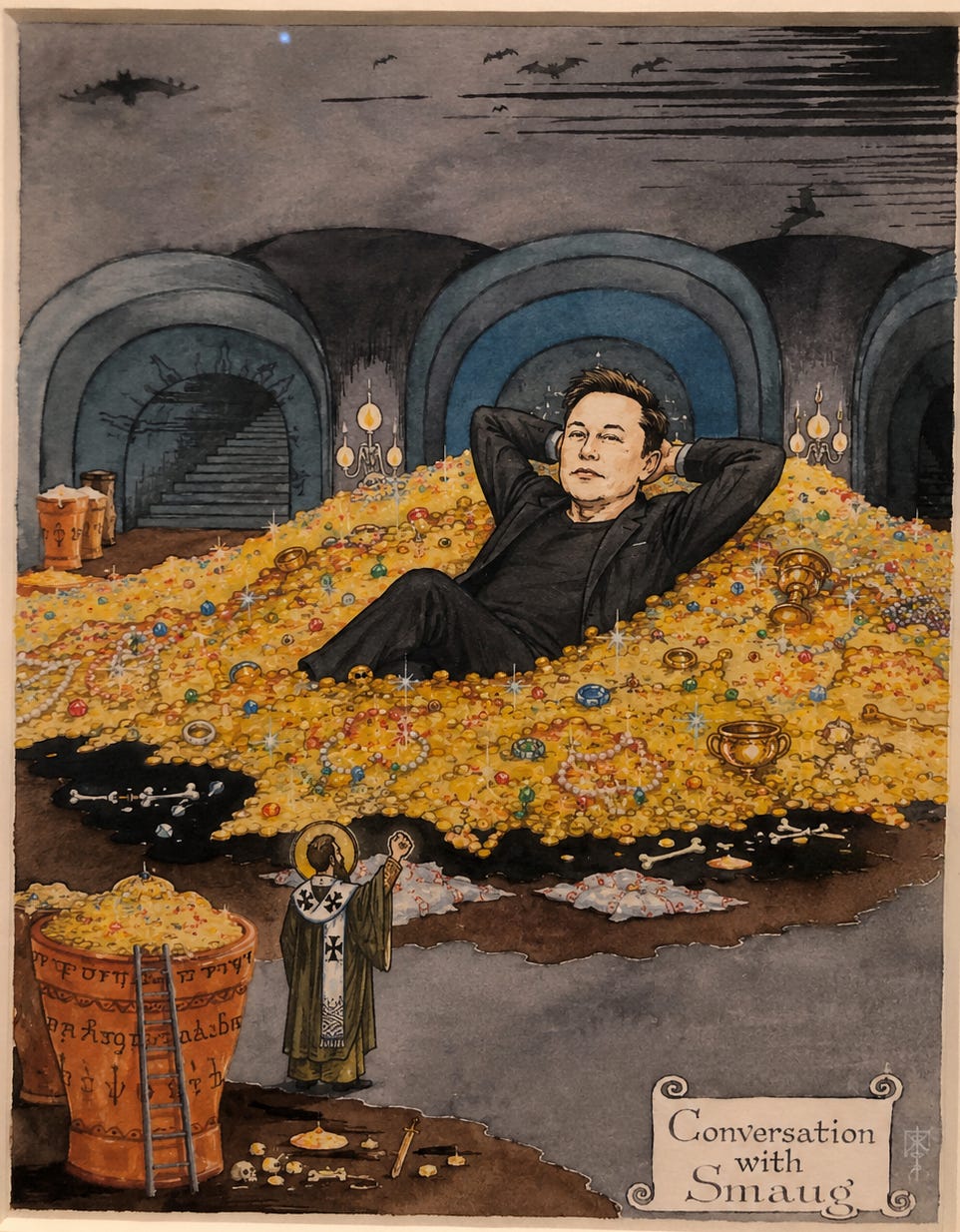
If St. Basil is accurate in his summary of Christian morality as pertains to wealth, then regardless of how rightly ot earnestly they “earned” their wealth, billionaires are dragons. They are beasts of power, hoarding excess at the expense of the vulnerable, demanding the death of innocents and the sacrifice of communities for no other reason than to add to their selfish and pointless pile. And I find myself asking with increasing frequency why Christians are not more vocal about this. Why have we chosen to focus almost the entirety of our cultural efforts on subjects the Bible barely touches on, while flatly ignoring a subject the Bible speaks about more than almost anything in the entire text? History has demonstrated over and over and over and over, across continents and cultures, how frequently and readily the rich oppress the poor at every given opportunity, how quickly the poor are viewed as disposable for the meager increase of anyone financially above them, and how antithetical the pursuit of material gain is to the love of God. All of human history testifies to the Biblical claim that the love of money is the root of all kinds of evil. And perhaps that’s what really lies at the core of Christ’s command to eschew wealth. Maybe it isn’t just simple temptation or a spiritual lesson about true treasure; maybe it’s meant to highlight that so long as there are those who choose prosperity over love, evil will persist, and man will suffer at the hands of his fellow man for meaningless increase. Even the rich young man in the Gospel account, who kept God’s law perfectly, could not bring himself to surrender his material wealth to follow God when invited. This is not a trivial or easy call, it strikes against the very heart of our self-interested nature.
But unlike so many of us, Basil took this invocation seriously. He divested himself of personal wealth and dedicated his life to ministry. He (somewhat ironically) became an effective fundraiser, building soup kitchens to combat famine, establishing reform programs for robbers and prostitutes, and most notably, founding a philanthropic institution known as the Basiliad (or sometimes the Basileias), considered by many historians to be the first modern hospital. It offered free hospice, shelter, food, and medical care to anyone who needed them, staffed by dedicated monks from an adjacent monastery. St. Gregory Nazianzus, in Basil’s funeral homily, compared it to one of the great wonders of the ancient world.
Basil practiced what he preached, and he preached a lot, lambasting the wealthy of his day, demanding that they remember their ownership was, at best, stewardship, and that the hoarding of wealth was as stupid as it was evil. When we look at history’s endless manifestations of injustice predicated on economic disparity and see that truth reflected in the world around us, coupled with the practical wisdom of Christ’s teachings and their constant focus on the material realities of the poor and downtrodden, I can’t help but wish more prominent Christians today had St. Basil’s moral clarity and willingness to call dragons what they are.
“In just a little while, his life will be snatched away, and what is he thinking? 'I will pull down my barns and build larger ones.' Well done, I would say for my part. The treasuries of injustice well deserve to be torn down. With your own hands, raze these misbegotten structures. Destroy the granaries from which no one has ever gone away satisfied. Demolish every storehouse of greed, pull down the roofs, tear away the walls, expose the moldering grain to the sunlight, lead forth from prison the fettered wealth, vanquish the gloomy vaults of Mammon. 'I will pull down my barns and build larger ones.' But if you fill these larger ones, what do you intend to do next? Will you tear them down yet again only to build them up once more? What could be more ridiculous than this incessant toil, laboring to build and then laboring to tear down again? If you want storehouses, you have them in the stomachs of the poor.”

Incidentally, I think this is also why loquaciously opprobrious writers like David Bentley Hart can be so appealing to Christians with similar temperaments to myself.
I don’t care how many centuries we’ve spent weakening Jesus’ words; Matthew 19 and Luke 18 are unambiguously talking about those who are rich/those with wealth, not certain kinds of wealthy people (like those who misuse their wealth or something). The declaration is that it is humanly impossible for the wealthy to enter the Kingdom of Heaven, full stop. Do with that what you will, but that is the claim of the text.
Basil, I Will Tear Down My Barns 6
Basil, In Time of Famine and Drought 7
I will not pretend to be someone who can write with any broad expertise on economic systems. I’ve never been a staunch capitalist or ardent anti-capitalist for the simple reason that I am not educated on the matter beyond the most surface-level smattering of basics. I also find myself weary before even beginning to assess such things, as we live in a rhetorical climate where blanketly blaming all our woes on capitalism is as much an accepted practice as using “socialist” or “communist” as a slur. So please realize that inasmuch as I comment on these systems, I’m far more interested in their underlying ideology than their pop-political manifestations.
I’ve seen a few scholars note that it was John Calvin and a few of the other reformers who were largely responsible for re-interpreting these teachings in light of the economic realities of their day, beginning the shift towards the attitudes we see today (proposing that charging interest on loans is a damnable sin would get you laughed out of most 21st century churches).
Say that five times fast.
i can’t help but wonder if the christian defense of this kind of evil is subconsciously related to the fetishization of power and authority that exists in so many evangelical circles. it’s like a reflexive trust in human hierarchy as inherently good. to use a crude term, it’s boot-licking at its finest, justified in biblical language.
“Loquaciously opprobrious” is so perfect